
What Wembanyama’s Blood Clot Taught Us About the Real Work of Sports Pharmacy
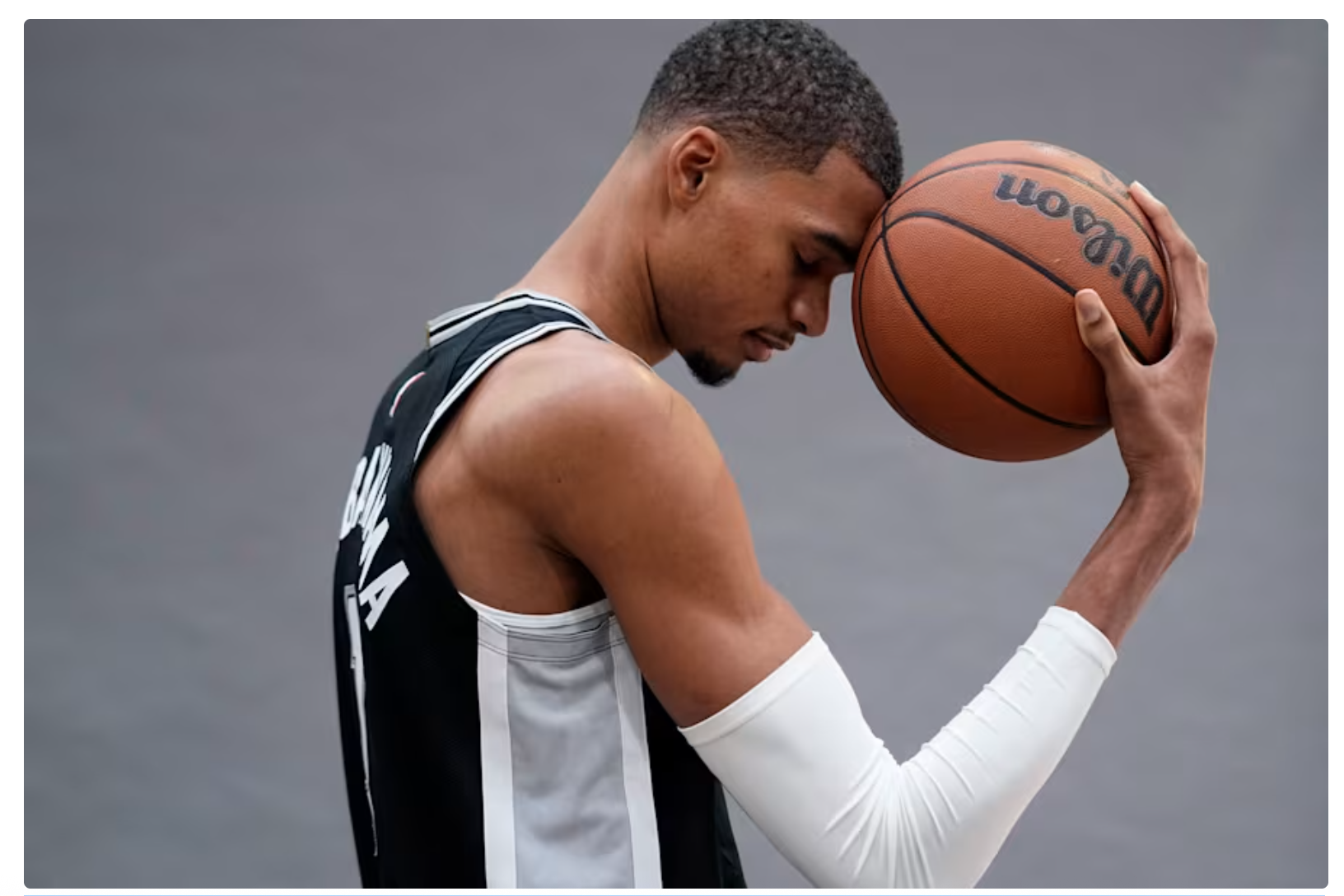
San Antonio Spurs center Victor Wembanyama, the NBA's first round draft pick, poses for photos during an NBA basketball media day in San Antonio, Monday, Oct. 2, 2023. (AP Photo/Eric Gay) (Eric Gay, Copyright 2023 The Associated Press. All rights reserved)
Tonight is game 1 of the NBA finals but back in February 2025, the basketball world held its breath when Victor Wembanyama — arguably the most anticipated player in a generation, maybe in NBA history — was diagnosed with a blood clot in his right shoulder. Season over. Timeline uncertain. The pressure to speculate, to panic, to rush, hit immediately.
The San Antonio Spurs did none of that.
And that decision — the one to slow down — is exactly what I want to talk about.
The Injury Behind the Headlines
Most people associate blood clots with the legs. Deep vein thrombosis. The warning label on long flights. But there’s a less discussed presentation that shows up specifically in overhead athletes — basketball players, pitchers, swimmers, tennis players — where repetitive motion creates sustained vascular compression near the shoulder. Blood flow gets restricted. Clot risk climbs.
For a 7’4” shooter with one of the most unusual release points in professional basketball, this wasn’t random. Elite performance creates elite stress on the body. And sometimes the body sends a message that cannot be managed around — only through.
A blood clot in the shoulder is serious. It can threaten performance, career longevity, and in worst-case scenarios, long-term health. This isn’t an injury you push through. It’s one you treat with precision, patience, and a team that keeps the athlete’s future — not the current season — as the north star.
The Spurs Did What Most Organizations Won’t
Here’s what stood out to me: the Spurs sat him down and kept him there.
This isn’t new behavior for that organization. During the 2000 NBA Playoffs, Tim Duncan tore his lateral meniscus. He wanted to play — Duncan always wanted to play. The Spurs said no. They pulled him for the entire postseason, prioritizing what came next over what was happening right now. That franchise went on to win five championships with Duncan healthy at the center of all of it.
The contrast worth studying is Grant Hill in Orlando. Hill played through a serious ankle injury before it had fully healed. The complications that followed reshaped — and shortened — a career that should have been all-time. Two approaches. Two very different outcomes.
There’s real pressure to rush a generational talent back onto the court. That pressure comes from everywhere — coaches, front offices, fans, and often the athletes themselves. The Spurs have consistently demonstrated that the best medical decision is sometimes the hardest one to make. Patience, when the stakes are this high, is not softness. It’s precision.
Wembanyama came back. He’s playing at a level that confirms every day of that waiting was worth it.
Where Sports Pharmacists Fit Into All of This
I’m a sports pharmacist — a PharmD — and this story matters to me beyond fandom.
Sports pharmacists are often the last line of defense and, more importantly, the first line of education. We’re not on the court. We’re not calling plays. But we are in the room when the questions no one else is asking need to be answered: What medications interact with anticoagulation therapy? Which supplements are contraindicated right now? How do we manage pain without compromising the recovery protocol?
These aren’t abstract questions. They have real stakes — for performance, for safety, and for a player’s ability to have a career beyond this season.
Our responsibility extends well beyond filling prescriptions. We flag drug-supplement interactions. We monitor the full medication picture. We educate athletes on what recovery actually looks like — not the highlight reel version, but the disciplined, frustrating, day-by-day version that leads to a full return. And we hold the line when pressure mounts to move faster than the clinical evidence supports.
That last part is the hardest part. And it’s the most important.
Sports medicine works when it’s collaborative — physicians, physical therapists, pharmacists, nutritionists, and organizational leadership all aligned around one thing: the long-term health of the person in front of them. Not the box score. Not the standings. The person.
The Lesson in His Return
Wembanyama’s comeback isn’t just a feel-good story. It’s a case study. It shows what happens when the people around a gifted athlete make the right call at every decision point — when they prioritize the next ten years over the next ten games. That’s the model. That’s what we’re building toward at Hockaday Rx.
The scoreboard records wins and losses. The work we do in sports pharmacy is about something longer-lasting: the health, function, and future of the person we’re trusted to serve. That’s what good sports pharmacy does. It protects the next chapter.
Brandon Hockaday, PharmD, is the Clinical Director of Hockaday Rx, a pharmacist-led sports pharmacy and wellness venture based in Inglewood, CA. Hockaday Rx specializes in performance optimization, supplement safety, and whole-person care for athletes and active adults.